
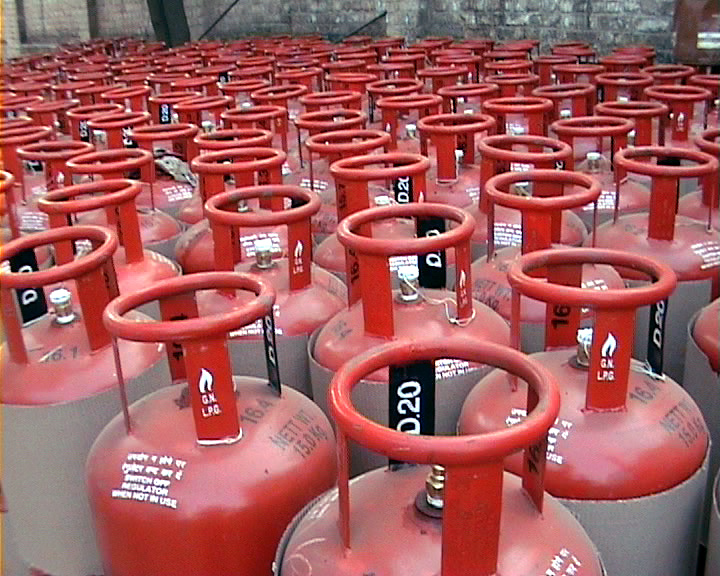
File Photo - Gas Cylinders (Wikimedia Commons)
ISLAMABAD: Pakistan’s oil and gas regulator has issued clear safety guidance for everyday consumers using liquefied petroleum gas cylinders at home, stressing that basic precautions can significantly reduce the risk of fires, leaks, and explosions.
The guidelines, issued by the Oil and Gas Regulatory Authority, focus on safe handling, proper storage, and prompt response to gas leaks, particularly for domestic users.
Proper placement and ventilation
OGRA advises consumers to always keep gas cylinders in open, well-ventilated areas and away from direct heat. Safety instructions emphasize that cylinders should never be placed in confined or poorly ventilated spaces.
“Always keep the cylinder in a safe and well-ventilated place,” OGRA safety material states, highlighting ventilation as a first line of defense against gas buildup.
Safe use during daily cooking
Households are advised to close the regulator immediately after use to prevent accidental leaks. OGRA guidance also warns against unsafe actions if a gas odor is detected.
“If you smell gas, never light a lighter, matchsticks, or turn on electric switches,” the safety notice says, noting that even a small spark can trigger a fire.
Immediate steps in case of leakage
In the event of a suspected leak, OGRA instructs consumers to act quickly but calmly. The guidance states that windows and doors should be opened immediately to allow gas to disperse.
“Immediately open windows and doors, and promptly inform the relevant gas or LPG companies,” the safety instructions say.
Household awareness and child safety
OGRA also emphasizes public awareness as a key safety measure. Consumers are encouraged to educate family members about proper cylinder handling, keep cylinders out of children’s reach, and ensure that safety valves and regulators are not tampered with.
The authority’s safety material highlights “proper usage and handling,” “child safety,” and “storage precautions” as essential steps for households.
Routine inspections are strongly encouraged to identify worn-out regulators, damaged pipes, or loose connections. OGRA guidance emphasizes early detection and adherence to leakage protocols, advising consumers to regularly check cylinder contents and fittings.
Regulations on LPG use
The use, storage, and distribution of liquefied petroleum gas in Pakistan are governed by detailed safety and licensing regulations aimed at reducing risk and ensuring public safety, according to official regulatory criteria issued in February 2024.
Under the rules, any company seeking to set up liquefied petroleum gas storage or filling facilities must obtain prior approval from the Oil and Gas Regulatory Authority.
“Any company entitled by its memorandum of association or any other appropriate instrument to engage in LPG business may apply to set up LPG storage and filling facilities,” the document says, adding that applications must be submitted on a prescribed form along with a nonrefundable fee of Rs 500,000.
The regulations require a separate, site-specific license for construction, which is issued only after verification by a third-party inspector. “A separate and site-specific licence for construction of LPG storage and filling facility or plant shall be granted by the Authority, after verification of the site by OGRA’s third-party inspector,” the criteria state.
Location restrictions are a central part of the framework. The rules specify that “the LPG storage and filling plant shall not be located in a residential or commercial area,” and that no residential or commercial building may exist within a 100-meter radius of the proposed site at the time of inspection.
Applicants are also required to demonstrate financial and technical capacity. The criteria mandate submission of a financial competence certificate from a Pakistani bank, confirming that the applicant has sufficient funds to undertake the project.
Latest News
Trump terms Iran deal a 'total and complete victory,' White House says discussing in-person talks
AN HOUR AGO
.jpg)
Vatican envoy's aid convoy to south Lebanon retreats after taking fire: Security source
11 HOURS AGO
Pakoras, samosas and tea: Food Pakistanis crave when it rains
13 HOURS AGO
French pair held in Iran 'free and on their way to France': Macron
13 HOURS AGO
Pakistan issues over 2,800 visas to Indian Sikhs for Baisakhi pilgrimage
14 HOURS AGO