
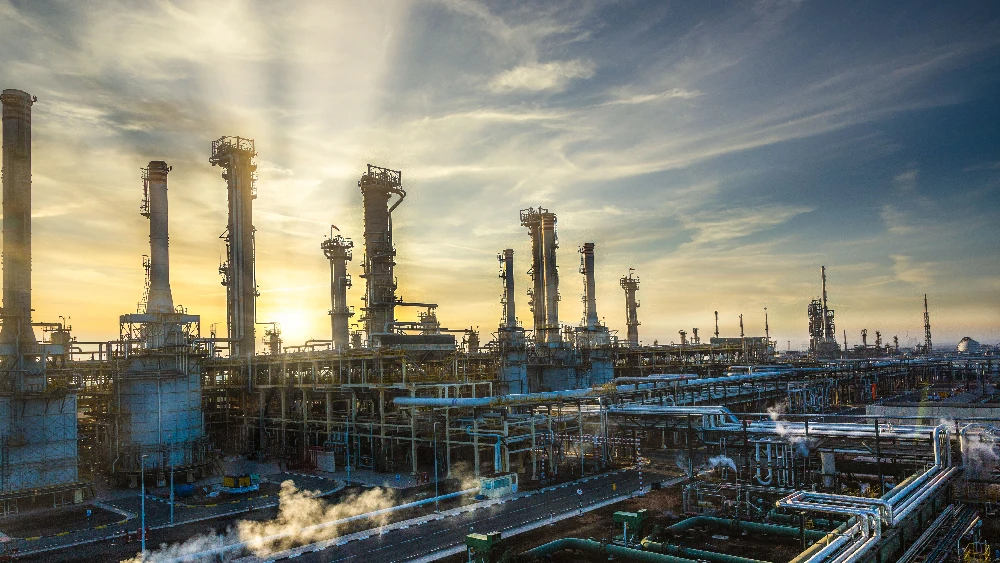
ADNOC refinery site in Ruwais, UAE. (File photo: Wikimedia Commons)
VIENNA: Seven OPEC+ members are meeting Sunday to make their first decision on oil-production quotas since the United Arab Emirates' departure from the cartel, which added to the soaring price pressure unleashed by the Mideast war.
The UAE, one of the world's top producers, announced April 28 it was withdrawing from the Organization of the Petroleum Exporting Countries (OPEC) and the expanded OPEC+ group, after chafing at its production quotas. The withdrawal took effect on Friday.
Neither group has reacted publicly so far — meaning there will be intense focus on the tone of the statement at the end of Sunday's online meeting by Algeria, Iraq, Kazakhstan, Kuwait, Oman, Russia and Saudi Arabia.
The production decision itself is already priced in by markets. The seven countries are widely expected to increase their quotas by 188,000 barrels per day (bpd), according to Arne Lohmann Rasmussen, chief analyst at Global Risk Management.
That is similar to a 206,000-barrel daily increase announced in March and April, subtracting the portion allotted to the UAE.
Quota question mark
But raising the quota on paper may not have much impact on actual production, which is already short of the limit.
Untapped OPEC+ reserves are mainly located in the Gulf region, and exports there are trapped by the blockade of the vital Strait of Hormuz, imposed by Iran in response to the US-Israeli strikes that started the war on February 28.
"Total OPEC+ output with quota fell to 27.68 million bpd in March, against a monthly quota of 36.73 million bpd, a shortfall of approximately 9 million bpd driven almost entirely by war-related disruption rather than voluntary restraint," said Priya Walia, an analyst at Rystad Energy.
The blockade is hitting Iraq, Kuwait, Saudi Arabia and the UAE. The latter's production will no longer count towards OPEC quotas.
Iran, whose exports are now the target of a retaliatory US blockade, is an OPEC+ member but is not subject to quotas.
Russia, the group's second-biggest producer, has been the main beneficiary of the situation. But despite soaring energy prices, it appears to be struggling to produce at the level of its current quotas as its own war in Ukraine drags on.
'Big deal'
The UAE's exit is "a big deal" for OPEC, said Amena Bakr, an analyst at Kpler.
Previous withdrawals from the group by Qatar in 2019 and Angola in 2023 were less significant by comparison, she told a video conference on the UAE withdrawal.
Besides being the fourth-biggest OPEC+ producer by output, the UAE has major untapped production capacity, an important lever when the group needs to regulate the market.
"The UAE had brought up grievances over its quotas", going back to 2021, said Bakr.
The UAE has invested massively in infrastructure in recent years, and state-owned oil company ADNOC plans to increase output by five million barrels a day by 2027 -- far above the country's last quota of around 3.5 million barrels.
That makes the UAE a competitive player that can produce at low cost — potentially limiting the impact of efforts by Saudi Arabia and its allies to shape the market.
There is also the risk for OPEC+ that other countries will leave, such as Iraq and Kazakhstan, which have faced repeated accusations of surpassing their quotas.
Latest News
Delhi administration accused of targeting Muslim-owned businesses
2 HOURS AGO

Two in three Gaza children are rotting in plague-ridden camps
2 HOURS AGO
.jpg)
Two women migrants die off French coast seeking to reach UK: Officials
2 HOURS AGO
.jpg)
Pakistan reaffirms press freedom commitment as global rankings improve
5 HOURS AGO
.jpg)
US midterm race enters last six months with Congress at stake
6 HOURS AGO