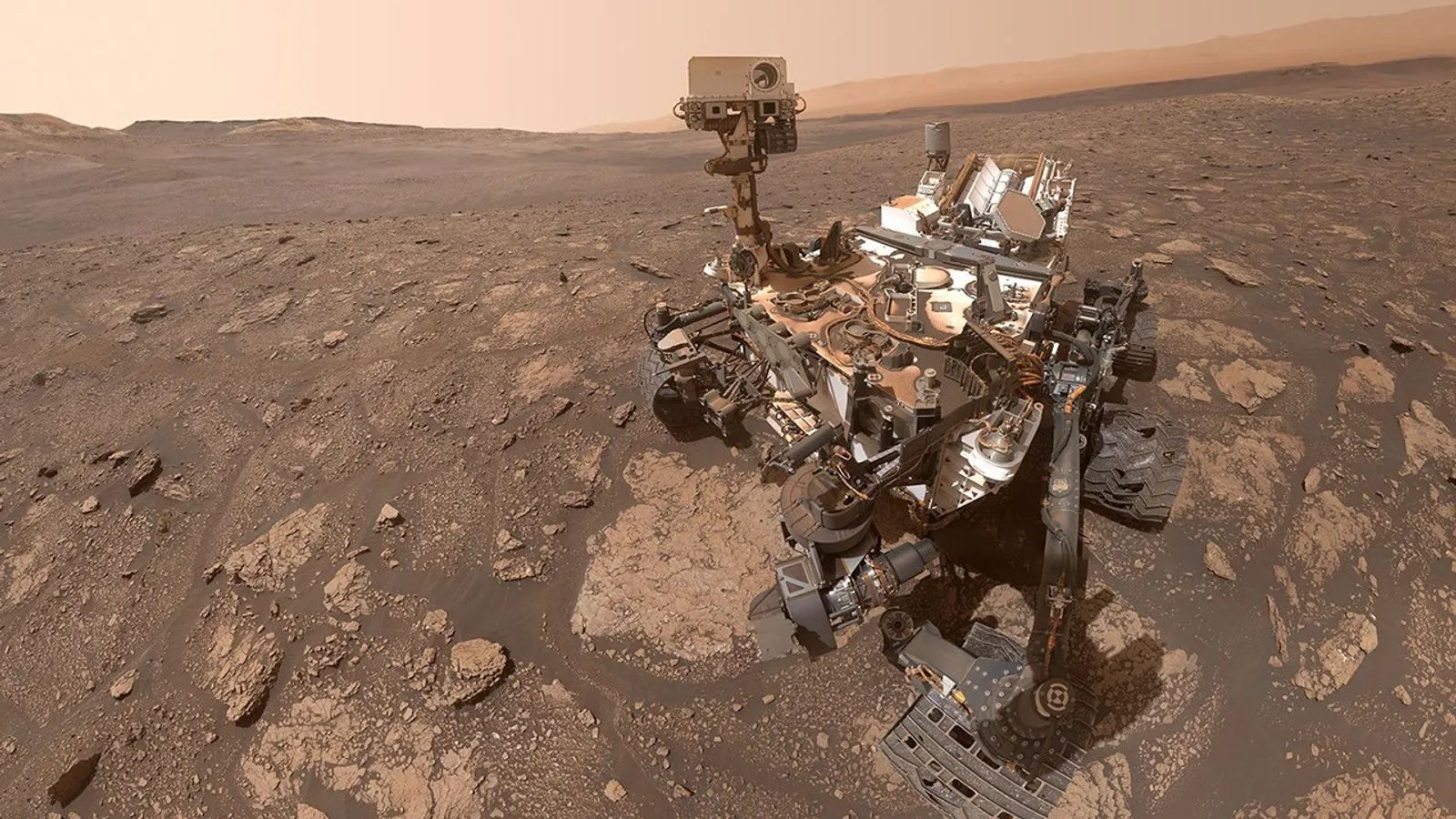
ISLAMABAD: NASA announced on Tuesday that its Curiosity Rover has discovered the most diverse set of organic molecules ever identified on Mars.
The discovery included seven carbon-containing molecules never seen there before.
The announcement came in a release from NASA’s Jet Propulsion Laboratory, based on a paper published the same day in Nature Communications.
In simple terms, organic molecules are chemical compounds built around carbon.
They matter because they are part of the chemistry linked to life, though their presence does not, by itself, prove that life existed.
NASA stressed that scientists still do not know whether these molecules were formed by living things long ago or by non-living geological processes.
The molecules were found in a rock sample drilled by Curiosity in 2020.
The sample came from a spot nicknamed Mary Anning 3 on Mount Sharp. NASA said this area was once covered by lakes and streams billions of years ago.
Over time, the region became rich in clay minerals.
That is important because clay can preserve ancient chemicals for very long periods.
This is why the finding matters so much.
Even after billions of years of radiation and harsh Martian conditions, these compounds survived in the rock.
NASA said the result adds to evidence that ancient Mars had the right chemistry to potentially support life.
One of the most significant discoveries was a nitrogen heterocycle, a ring-shaped molecule containing nitrogen.
NASA said this kind of structure is considered a chemical precursor to more complex compounds connected to RNA and DNA, which carry genetic information in life on Earth.
Another important molecule found was benzothiophene.
NASA said it contains carbon and sulfur.
The agency added that it has also been seen in meteorites and is useful for studying the kinds of chemistry that may have helped set the stage for life in the early solar system.
The testing was done using Curiosity’s onboard mini-laboratory, Sample Analysis at Mars, or SAM.
NASA said the Mary Anning 3 sample was the first Martian sample treated with a powerful chemical solution called TMAH, which helps break larger compounds into smaller pieces that are easier to detect.
NASA said the work could also help future space missions.
Parts of SAM are already being adapted for the European Space Agency’s Rosalind Franklin rover and for NASA’s Dragonfly mission to Saturn’s moon Titan.





.jpg)