
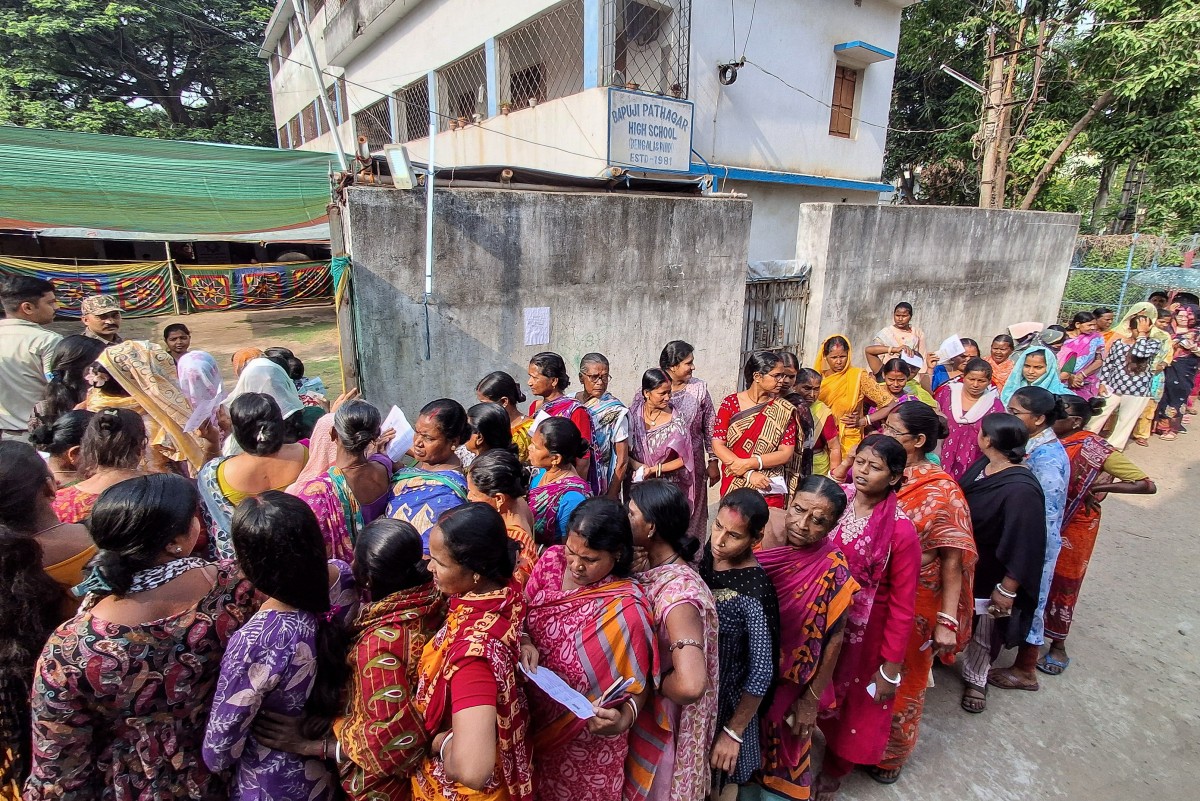
Voters queue up to cast their votes outside a polling station during the West Bengal Legislative Assembly elections in Berhampore, Murshidabad district, on April 23, 2026. (AFP)
ISLAMABAD: India held state elections this week in Tamil Nadu and West Bengal, two of its most politically consequential states. Both contests were shadowed by allegations that Prime Minister Narendra Modi's federal government used its institutional power to tilt the outcome: through a televised address that opponents say broke campaign law, the mass deletion of voters from electoral rolls in West Bengal, and the forced removal of senior state officials by an election body critics say is no longer neutral.
Five days before polls opened, Modi addressed the nation on Doordarshan and Sansad TV – India's state-owned broadcaster and parliament channel, both funded by the federal government. The address aired while the Model Code of Conduct was in effect. That code is a constitutionally recognized set of rules that bars incumbents from using government resources or platforms for political purposes once an election is called.
Communist Party of India MP P. Sandosh Kumar filed a formal complaint with the Chief Election Commissioner, arguing the broadcast was "political in nature" and contained "partisan assertions" designed to sway voters, according to The Hindu.
West Bengal Chief Minister Mamata Banerjee called it an "illegal campaign," as reported.
Tamil Nadu Chief Minister M.K. Stalin warned that BJP campaign visits to his state were accompanied by the "denial of funds" for essential development, a reference to a persistent grievance among India's opposition-governed states that New Delhi withholds centrally allocated budgets as political leverage.
Shiv Sena MP Sanjay Raut separately stated the BJP was using government funds to bus specific voter groups to polling stations, according to The Hindu.
Tamil Nadu: Fund denial, election coupons
In Tamil Nadu, where the incumbent Dravida Munnetra Kazhagam (DMK) party faces a BJP-backed opposition alliance, the interference allegations ran alongside a separate financial scandal.
The Madras High Court began hearing cases on April 16 against candidates from both major alliances over the alleged distribution of coupons worth between ₹8,000 ($84.86) and ₹10,000 ($106), redeemable at designated commercial outlets. Prosecutors say this method was designed to evade cash-seizure checks.
By April 22, federal authorities had seized more than ₹1,000 crore (approximately $106 million) in cash, liquor, and inducements across both Tamil Nadu and West Bengal combined, according to The Hindu.
West Bengal: Voter deletions
In West Bengal, the ruling Trinamool Congress (TMC) — a regional party that has governed the state since 2011– faces its toughest election yet against Modi's BJP. The central controversy before votes were cast was the deletion of roughly 12% of the state's total registered voters from the electoral rolls.
The Election Commission of India, the country's constitutionally ‘independent’ elections body, carried out the revision. Of the voters removed, 34% were Muslim, according to the Institute of South Asian Studies at the National University of Singapore. This is well above the community's 27% share of the state's population.
The TMC called the deletions a "deliberate design" to target its core supporters, per The Hindu. The BJP said the exercise was necessary to remove undocumented Bangladeshi migrants who had obtained fraudulent Indian identity documents through "TMC-backed syndicates".
India's Supreme Court ordered on April 17 that voters cleared by appellate tribunals before April 21 must be allowed to vote. Only 139 people were cleared in time for Phase I, as reported by local news outlets.
Officials removed, forces deployed
After the election was announced, the Election Commission transferred West Bengal's Chief Secretary, Home Secretary, Director General of Police, and Kolkata's top police officer along with 19 senior district police officers. This effectively removed the four most powerful state administrators from their positions.
While the ECI has legal authority to transfer officials during elections, Banerjee called the moves "political interference of the highest order" and "an assault on the Constitution," as reported by local media outlets,
The West Bank CM stated the commission was "campaigning for the BJP." Senior constitutional lawyer Kapil Sibal also said the commissioner's "vocation" appeared to be ensuring a BJP victory, as reported by The Hindu.
On April 21, the TMC stated that federal paramilitary troops (deployed under ECI orders and operating outside state government control) used "disproportionate criminal force" against residents in Nandigram, the home constituency of BJP's state opposition leader.
The ECI denied the claim.
According to the Association for Democratic Reforms, 23% of West Bengal's candidates had declared criminal cases, and constituencies where multiple candidates carry criminal records rose 17% from the previous election.
Tamil Nadu voted April 23. West Bengal's second phase is April 29. Results are due May 4.
Latest News
Pakistan FM chairs meeting on regional, global developments
AN HOUR AGO
Iranian delegation led by FM Araghchi expected to arrive in Islamabad tonight: govt sources
2 HOURS AGO
Modi broadcast, purged voter rolls shadow India's state elections
2 HOURS AGO
Pakistan, Iran signal continued engagement on regional issues
3 HOURS AGO
Bangladesh sweats as Mideast fuel shortages force power cuts
4 HOURS AGO