
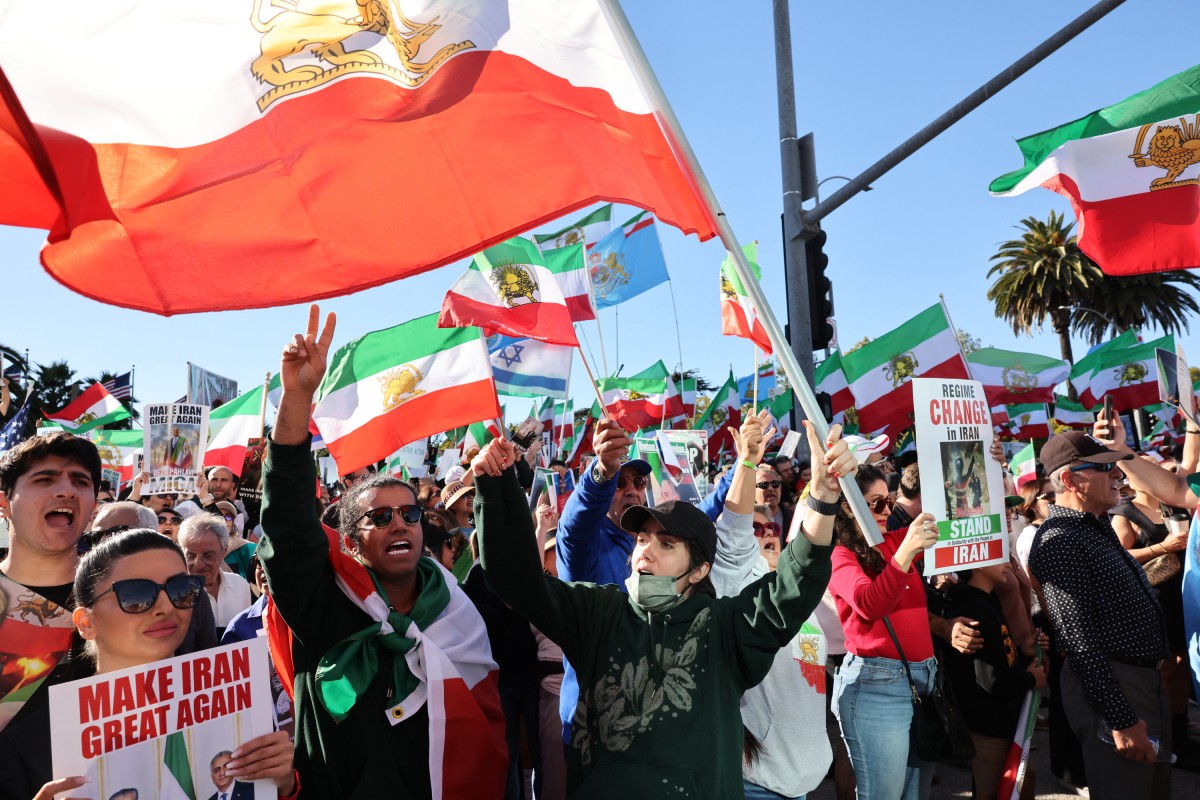
Activists take part in a “Free Iran” rally in Los Angeles, California, on January 11, 2026. (AFP)
ISLAMABAD: Iran, the United States, and Israel are trading conflicting claims over protests that erupted across Iran in late December, amid soaring prices, a collapsing currency, and mounting living costs.
According to Iranian officials and state media, the demonstrations began on December 28, 2025, when shopkeepers and merchants at Tehran’s Alaeddin Shopping Centre and other major commercial hubs went on strike over economic challenges.
Iranian state media reported sharp currency losses and rising prices in the days leading up to the protests. Traders in Tehran’s unofficial markets quoted the dollar at about 1.47 million rials, the Wall Street Journal reported last week.
Iran’s Statistical Center reported annual inflation of 42.2% in December, with food prices rising 72% year-on-year and health and medical items up 50%.
Within days, the unrest spread nationwide, and slogans moved beyond economic grievances to include direct criticism of Iran’s political leadership and clerical system.
According to Press TV, Iran's state media, the demonstrations were steered toward violence "after US and Israeli figures encouraged vandalism and disorder" through public statements.
Authorities deployed security forces across major cities and later imposed widespread restrictions on internet and mobile phone access.
The protests are the largest since the 2022–23 demonstrations triggered by the death of Mahsa Amini, according to Al Jazeera. Human rights groups say 550 people were killed in the crackdown, while Iranian authorities have put the death toll at fewer than 300.
Death toll and arrests
The US-based Human Rights Activists News Agency said 490 protesters and 48 members of the security forces have been killed, with more than 10,600 people arrested.
Separately, media affiliated with the Islamic Revolutionary Guard Corps reported that at least 114 security personnel had been killed since the unrest began.
Norway-based NGO Iran Human Rights said protests have spread to at least 100 cities across all 31 provinces, while internet monitoring group NetBlocks reported a communications blackout lasting more than 80 hours.
Iran, however, has not released official casualty figures.
Iran blames US and Israel
Tehran has squarely blamed the United States and Israel for fomenting the unrest.
Speaking in a live broadcast on state television, IRIB on Jan. 9, Supreme Leader Ayatollah Ali Khamenei distinguished between economic protesters and what he termed “rioters,” asserting that the latter must be “put in their place.”
President Masoud Pezeshkian, also speaking on state television, said the United States and Israel were ordering “rioters” to create instability, claiming that “the same people that struck this country” during Israel’s 12-day war in June were now seeking to escalate unrest through economic pressure.
Parliament Speaker Mohammad Baqer Qalibaf warned on Sunday that any US attack on Iran would make American bases and Israel “legitimate targets,” according to the official transcript carried by the Islamic Republic News Agency.
“In the event of an attack on Iran, both the occupied territory and all American military centers, bases, and ships in the region will be our legitimate targets,” he said.
US rejects accusations
Washington has firmly rejected Tehran’s claims. On Friday, Jan. 9, a US State Department spokesperson described Iranian Foreign Minister Abbas Araghchi’s remarks as “delusional.”
“This statement reflects a delusional attempt to deflect from the massive challenges the Iranian regime faces at home,” the spokesperson said.
President Donald Trump has issued increasingly forceful warnings. On Jan. 2, he wrote on Truth Social: “If Iran shoots and violently kills peaceful protesters, which is their custom, the United States of America will come to their rescue. We are locked and loaded and ready to go.”
“The military is looking at it, and we’re looking at some very strong options,” he added aboard Air Force One, while also saying Iranian officials had reached out about possible talks.
Trump said on Sunday he would speak to Elon Musk about restoring internet access in Iran through Starlink satellite services.
Israel’s stance
Israeli Prime Minister Benjamin Netanyahu said Sunday that he hoped Iran would soon be freed from what he described as the "yoke of tyranny", as major protests shake the Islamic Republic, AFP reported.
"When that day comes, Israel and Iran will once again be loyal partners in building a future of prosperity and peace for both peoples," Netanyahu said at a weekly cabinet meeting, according to a video released by his office.
"Israel is closely monitoring events in Iran," he added.
According to AFP, Israel's Foreign Minister Gideon Saar urged the European Union to designate Iran's Revolutionary Guards Corps as a "terrorist organization."
Iran and Israel engaged in a war in June that saw unprecedented Israeli attacks on Iranian military and nuclear facilities.
Diplomatic signals amid crisis
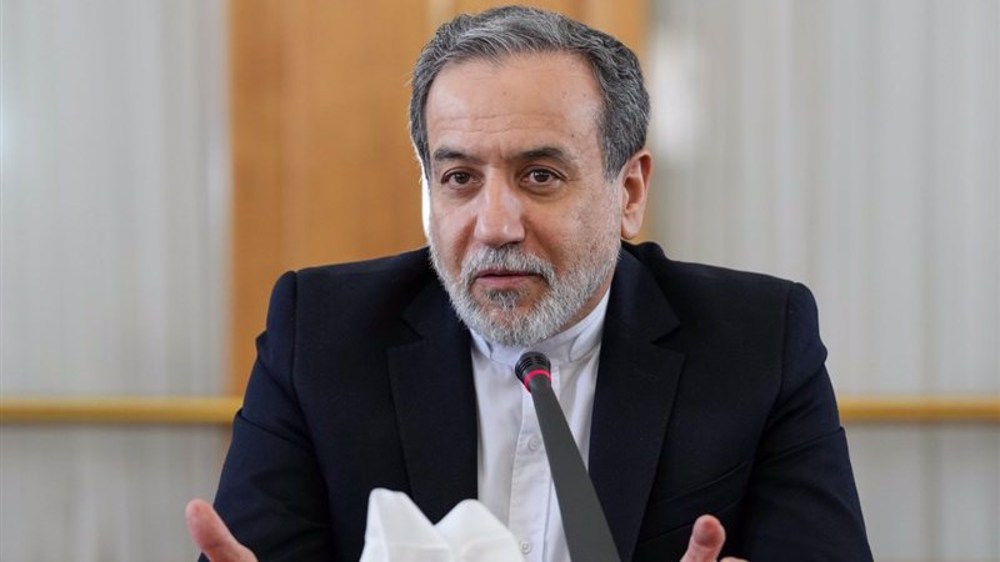
Despite the confrontational rhetoric, Iran has sent mixed diplomatic signals. Foreign Minister Araghchi, speaking during a visit to Beirut, said Tehran remained open to negotiations if Washington abandoned what he called coercive tactics.
“Iran does not want war with Israel or the United States,” he said, adding the country was “ready to fight back if attacked again".
Authorities have declared three days of national mourning for what state media described as “martyrs killed in resistance against the United States and the Zionist regime”.
The UN High Commissioner for Human Rights, Volker Turk, called for an independent investigation into reported deaths and mass arrests.
Iran’s UN ambassador urged the Security Council to condemn what he described as unlawful US threats.
Latest News
Fact check: No US military use of Pakistan for Iran operations
31 MINUTES AGO
Pakistan showcases security tech at world's largest safety exhibition
AN HOUR AGO

Amy Poehler's 'Good Hang' wins first-ever Golden Globe for Best Podcast
2 HOURS AGO

Safety guidelines for households using gas cylinders
3 HOURS AGO
Iran ready for war and talks, but rejects diktats, says FM Araghchi
5 HOURS AGO