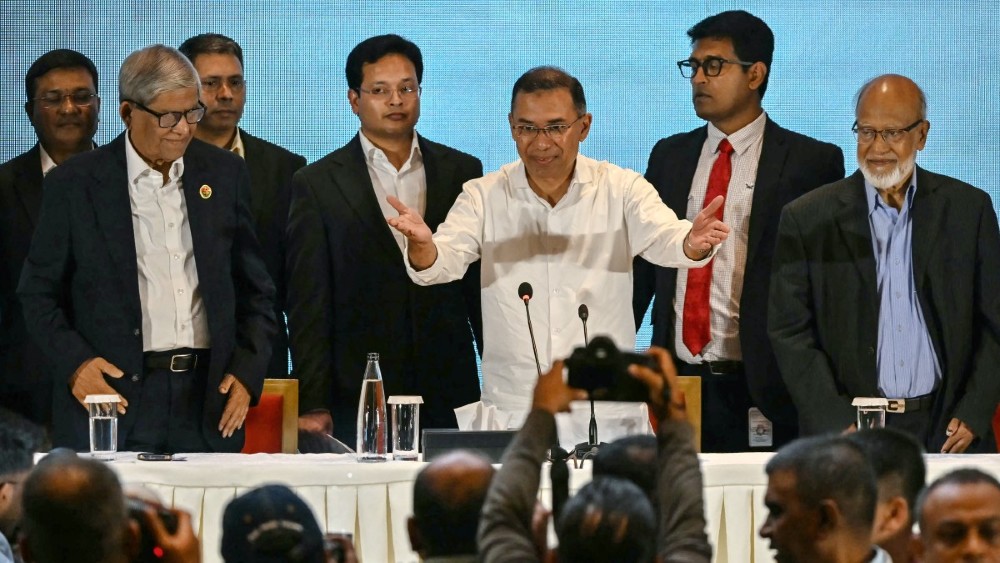
DHAKA: Bangladesh’s prime minister-in-waiting Tarique Rahman on Saturday called for national unity and a reset in regional engagement, signaling renewed outreach across South Asia after his party’s sweeping victory in the country’s first competitive election since the 2024 uprising.
“Our paths and opinions may differ, but in the interest of the country, we must remain united,” Rahman said at his first post-election press conference. “National unity is a collective strength. Division is a weakness.”
Dedicating the victory to pro-democracy activists, Rahman said, “This victory belongs to Bangladesh. It belongs to democracy. It belongs to the people who aspired to and sacrificed for democracy.”
Rahman’s Bangladesh Nationalist Party secured more than two-thirds of parliamentary seats, positioning him to form the next government after nearly two decades in political exile.
Focus on India, Pakistan and SAARC
Pressed on relations with India, Rahman said Dhaka would prioritise strategic interests over ideology.
“We do not have country-centric policies,” he told an Indian journalist. “Our strategic interests come first. We prefer mutual, bilateral ties based on respect.”
On regional diplomacy, Rahman said Bangladesh would seek to revive the SAARC, noting Dhaka’s historical role in launching the forum.
“As you know, SAARC was initiated by Bangladesh,” he said. “We will try to re-initiate that process.”
Asked whether Bangladesh could act as a negotiating bridge between India and Pakistan following tensions after the May 2025 crisis, Rahman said regional stability remained a priority but stopped short of committing to formal mediation.
On the sensitive question of former prime minister Sheikh Hasina’s status in India, Rahman said any decision would follow due process. “The handing-over issue depends on legalities,” he said.
Domestic challenges acknowledged
Rahman acknowledged the scale of challenges facing the incoming administration.
“We are about to begin our journey in a situation marked by a fragile economy left behind by an authoritarian regime, weakened constitutional institutions and a breakdown in law and order,” he said. “Restoring democracy is only the first step. Ensuring good governance is the real test.”
Responding to suggestions that his party’s large majority could enable political “engineering,” Rahman rejected the claim.
“I think we engineered our campaign so that people would come out and vote,” he said. “We have been given a mandate by the people.”
He said the new government would listen closely to young voters while governing inclusively. “Naturally we will listen to the youth, but we have other people in the country too, and we will take care of them as well.”
Election and reform
Rahman’s remarks came as Bangladesh concluded its 13th National Parliamentary Election, the first since a 2024 uprising ended 15 years of authoritarian rule.
Final results show the BNP winning 209 seats outright, rising to 212 with allies. Bangladesh Jamaat-e-Islami secured 68 seats, rising to 77 with alliance partners, emerging as the largest opposition force. Overall voter turnout stood at 59.44%.
Running alongside the election, voters also endorsed the July National Charter in a nationwide referendum. More than 70 million ballots were cast, with nearly 48 million voters, about two-thirds, backing constitutional reforms aimed at limiting executive power, strengthening judicial independence, and restructuring parliament.
European Union observers described the elections as credible, calling them “a pivotal step towards restoring democratic governance and the rule of law.”
From the opposition, Jamaat chief Shafiqur Rahman accepted the outcome, pledging to act as a “vigilant, principled and peaceful opposition.”
Pakistan-Bangladesh ties
International reaction, particularly from Pakistan, framed the outcome as a milestone for democratic continuity. Prime Minister Shehbaz Sharif telephoned Rahman to congratulate him on what he termed a “historic and resounding victory,” reaffirming Islamabad’s commitment to strengthening bilateral cooperation.
President Asif Ali Zardari also congratulated Rahman and the people of Bangladesh on the successful and peaceful conduct of the polls, while Deputy Prime Minister and Foreign Minister Ishaq Dar said Pakistan would continue to engage Bangladesh “on the basis of sovereign equality and mutual respect.”
With a clear mandate at home and reform legitimacy secured at the ballot box, Rahman now faces the task of translating electoral momentum into governance, while redefining Bangladesh’s regional posture in a fractured South Asian landscape.



.jpg)
.jpg)