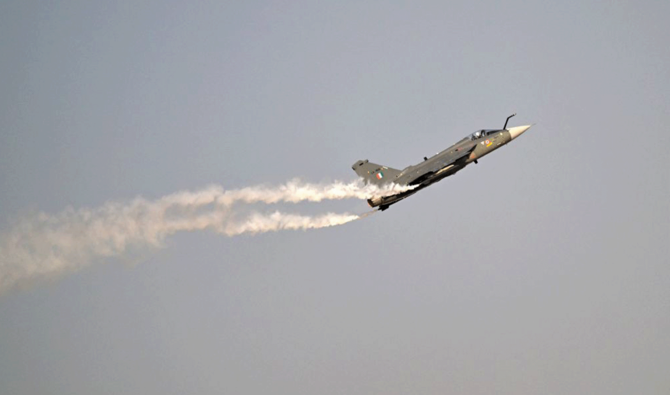
ISLAMABAD: A recent incident involving India’s indigenous Tejas Light Combat Aircraft has renewed scrutiny of the program’s safety record and long-term reliability, marking the third serious mishap since the aircraft entered operational service.
According to Indian media reports citing defense officials, a Tejas fighter jet overshot a runway earlier this month and veered into a ditch during landing after a suspected brake failure. The single-seat aircraft was operating on a routine training sortie. The pilot survived but sustained injuries. The incident was not publicly disclosed at the time.
Officials told local outlet, The Print, the accident occurred on February 7 at a major Indian Air Force base during the landing phase. India’s defense ministry has so far issued no official statement regarding the episode.
The runway incident adds to a growing list of setbacks for the Tejas program. In March 2024, a Tejas jet crashed near Jaisalmer while returning from a firepower demonstration. The pilot ejected safely, but the aircraft was destroyed. In November 2025, another Tejas was lost during an aerobatic display at the Dubai Airshow after reportedly losing control, killing Wing Commander Namannsh Syal.
The Tejas, developed by India’s Aeronautical Development Agency and produced by Hindustan Aeronautics Limited for the Indian Air Force and Navy, is a single-engine, 4.5-generation multirole fighter. It first flew in 2001 and was inducted into service in 2015, after years of delays.
While Indian officials continue to describe Tejas as a cornerstone of the country’s self-reliance drive in defense manufacturing, aviation analysts say the pattern of incidents is drawing attention within the global pilot and aerospace community.
“Repeated non-combat losses inevitably raise questions about systems maturity,” a former Western test pilot familiar with light fighter programs said. “Brake reliability, flight control software, and maintenance integration are all areas that tend to surface when an aircraft is pushed into regular operations.”
Defense observers further point out that single-engine fighter aircraft inherently operate with narrower safety margins. Without propulsion redundancy, they say, any system malfunction, especially during critical phases like landing, can quickly escalate into a serious incident.
Analysts stress that while this does not automatically indicate a flawed design, it places significantly higher demands on reliability, maintenance standards, and pilot workload management.
Observers say the lack of transparency surrounding recent incidents may further complicate confidence in the program, particularly as India seeks to market the Tejas internationally.
Once promoted as a symbol of India’s technological leap in combat aviation, the Tejas program is now confronting renewed debate over sustainability, operational efficiency, and safety. Questions that are likely to intensify unless addressed openly by authorities.