DHAKA: Bangladesh swore in its new prime minister on Tuesday amid heavy security and widespread celebrations, following a landslide election that marked the country’s first national vote since the mass 2024 uprising that ended years of "authoritarian rule."
The capital, Dhaka, was placed under tight security throughout the day, with major roads repeatedly opened and closed to accommodate high-profile movements. Traffic across large parts of the city was severely disrupted, leaving commuters stranded for hours.
Following the oath-taking ceremony, supporters of the Bangladesh Nationalist Party (BNP) poured onto the streets, chanting slogans and holding celebratory rallies. Crowds also gathered outside the parliament complex, lining the road beyond the main gate to witness the historic transition.
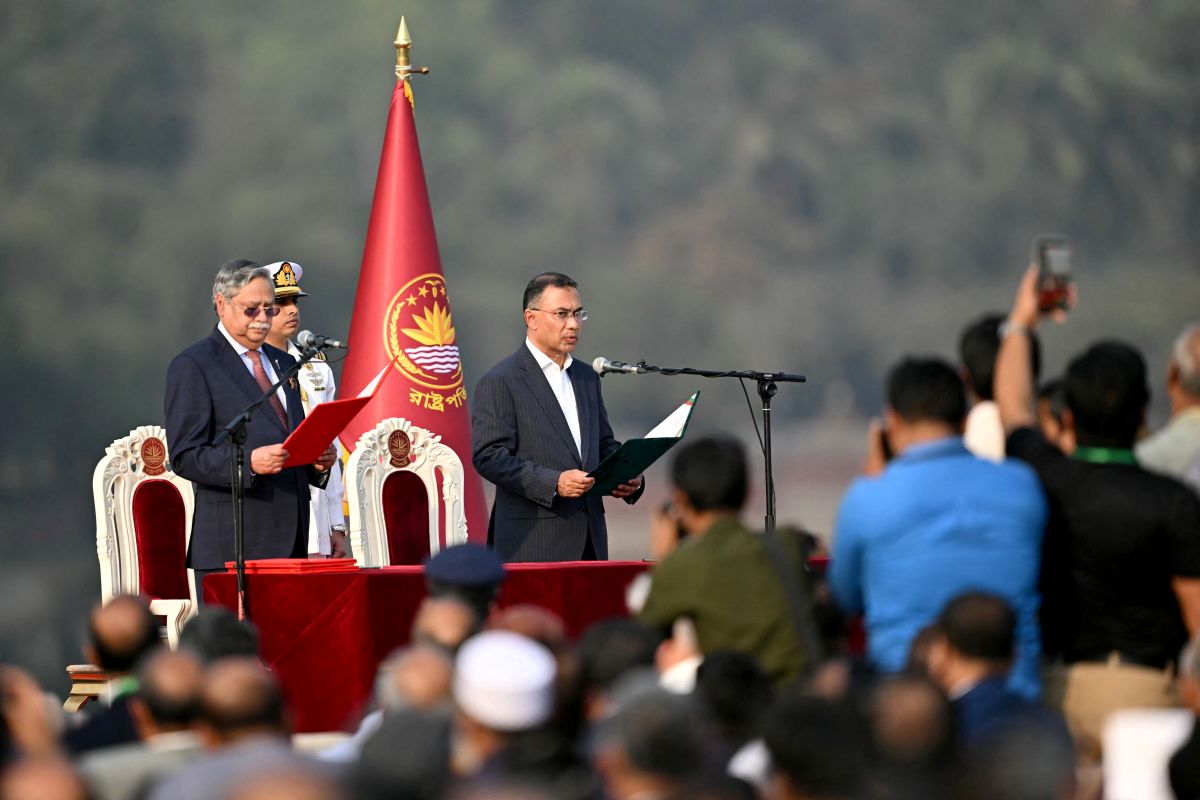
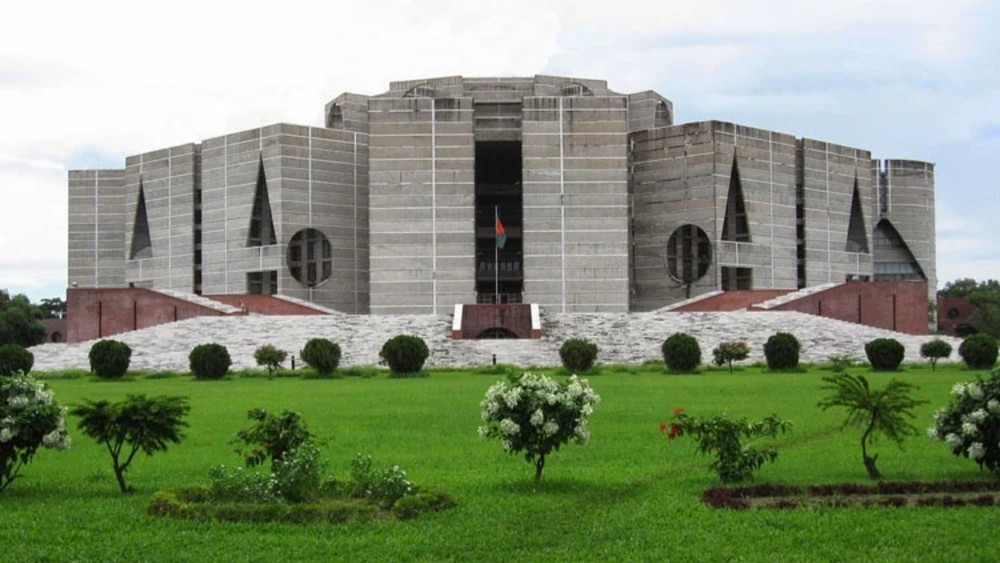
Prime Minister Tarique Rahman, whose five-year term begins immediately, was sworn in by President Mohammed Shahabuddin at a ceremony held at the South Plaza of the National Parliament.
Rahman, 60, is the son of former prime minister Khaleda Zia and former president Ziaur Rahman. He is Bangladesh’s first male prime minister in 35 years. Since the restoration of democracy in 1991, the office had alternated exclusively between his mother and her longtime rival Sheikh Hasina.
Rahman returned to Bangladesh in December last year after 17 years in self-imposed exile in London, shortly before his mother’s death. He has pledged to restore democratic institutions in the South Asian nation of around 170 million people.
The BNP and its allies secured 212 seats in the 350-member parliament, giving the party a decisive majority. An opposition alliance led by Jamaat-e-Islami won 77 seats, while smaller parties and independents filled the remainder. Of the 300 directly elected seats, voting was held in 299 constituencies.
Seven women were elected directly in the 13th national election, six of them on the BNP ticket. An additional 50 seats are reserved for women and allocated proportionally among winning parties.
Security, crowds and public mood
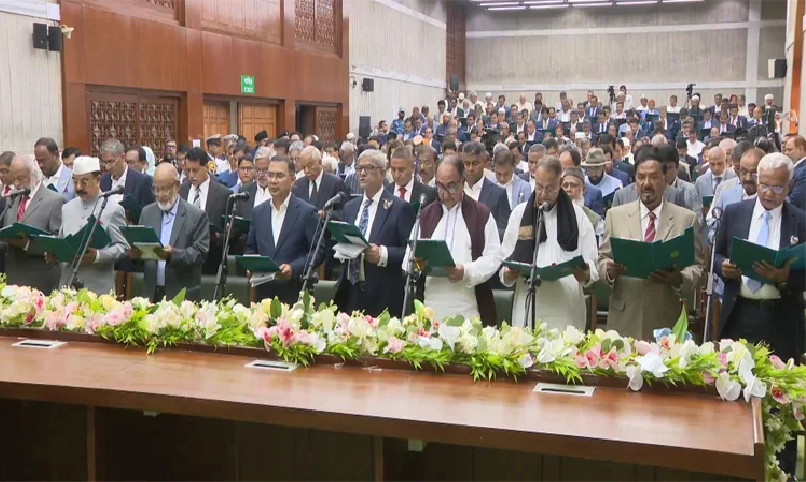
Earlier in the day, the head of the Election Commission administered the oath of office separately to all newly elected lawmakers. The presence of multiple foreign delegations prompted extensive security arrangements, with checkpoints and police deployments across central Dhaka.
Despite disruptions, the atmosphere around parliament was celebratory. BNP supporters waved party flags and described the day as the culmination of years of political struggle and disenfranchisement.
Pakistan signals engagement
Foreign dignitaries attending the ceremony included Maldives President Mohamed Muizzu, Bhutanese Prime Minister Tshering Tobgay, an Indian delegation, and representatives from Nepal, Sri Lanka and other countries.
Pakistan was represented by Planning and Development Minister Ahsan Iqbal, who said he was attending on behalf of Prime Minister Shehbaz Sharif.
“I am here to represent the Prime Minister of Pakistan and the people of Pakistan at a very historic moment when Bangladesh is making a democratic transition and a new government is being sworn in,” Iqbal told Pakistan TV Digital.
“Prime Minister Shehbaz Sharif would very much like to visit Bangladesh as early as possible,” he added.
Iqbal said Islamabad viewed the change in Dhaka as an opportunity to deepen bilateral ties, particularly in trade, investment and people-to-people engagement.
“There is tremendous opportunity to promote trade between Pakistan and Bangladesh,” he said, noting that bilateral trade remains below $1 billion. “We look forward to a new journey between Pakistan and Bangladesh, towards prosperity and stability, not only for our region but for our people.”
Cabinet takes shape
A total of 25 full ministers and two state ministers were sworn in as part of Rahman’s new cabinet, covering portfolios ranging from finance and home affairs to foreign policy, energy, climate change and social welfare.
Key appointments include Amir Khasru Mahmud Chowdhury to finance and planning, Salahuddin Ahmed to home affairs, Mirza Fakhrul Islam Alamgir to local government, and Khalilur Rahman, a technocrat, as foreign minister.
The election was overseen by an interim administration led by Nobel Peace Prize laureate Muhammad Yunus, which took charge after Sheikh Hasina was toppled during the 2024 uprising.
Hasina’s Awami League party was barred from contesting the vote, and all its political activities were suspended during the transition. From exile in India, Hasina rejected the election as unfair. At home, she has been sentenced to death on charges of crimes against humanity related to hundreds of deaths during the unrest.
The vote was largely peaceful and was deemed acceptable by international observers, restoring electoral legitimacy after years of disputed polls and political turmoil.
With a strong parliamentary mandate, a newly sworn-in cabinet and public celebrations spilling into the streets, Bangladesh’s new government begins its term under intense domestic expectations and renewed regional scrutiny.