ISLAMABAD: India's government spent years designing a new legal order for labor. It passed four codes that replaced 29 laws, promised streamlined dispute resolution, and called it reform. The first four months of 2026 were the stress test: the codes failed it.
The failure was not sudden. The Industrial Relations Code (Amendment) Bill, passed in February, repealed the foundational labor laws of 1926, 1946, and 1947 with retrospective effect, as reported by PRS India.
The government called this modernization. But the codes exclude establishments with fewer than 10 workers, leaving 93% of the workforce outside the scope of safety compliance, according to local media. The architecture was never built for the people it claimed to protect.
The Panipat refinery strike in February made that visible. Contractual workers at one of South Asia's largest refineries, formally excluded from many of the codes' provisions, reported 12-hour shifts without overtime pay, per Business and Human Rights Resource Centre. They refused to return without written assurances. These were not unionized workers operating within the dispute mechanisms created by the new codes. They were workers who had written out the codes.
That distinction matters. The Feb. 12 general strike drew 300 million participants across 600 districts, according to The Hindu, with union leadership declaring demands and organizing geography. It was large but legible. The April violence was neither.
When the channels break
When the West Asia conflict pushed black-market LPG prices from ₹500 to nearly ₹2,000, according to Reuters, for workers earning ₹500 to ₹800 rupees per day, the calculus became simple and brutal. While legislative grievances are negotiable, the inability to feed a family is not.
Haryana moved first. After sustained unrest in Manesar, the state ordered a 35% increase in the minimum wage, as reported by the Deccan Herald. The decision resolved Manesar and detonated Noida.
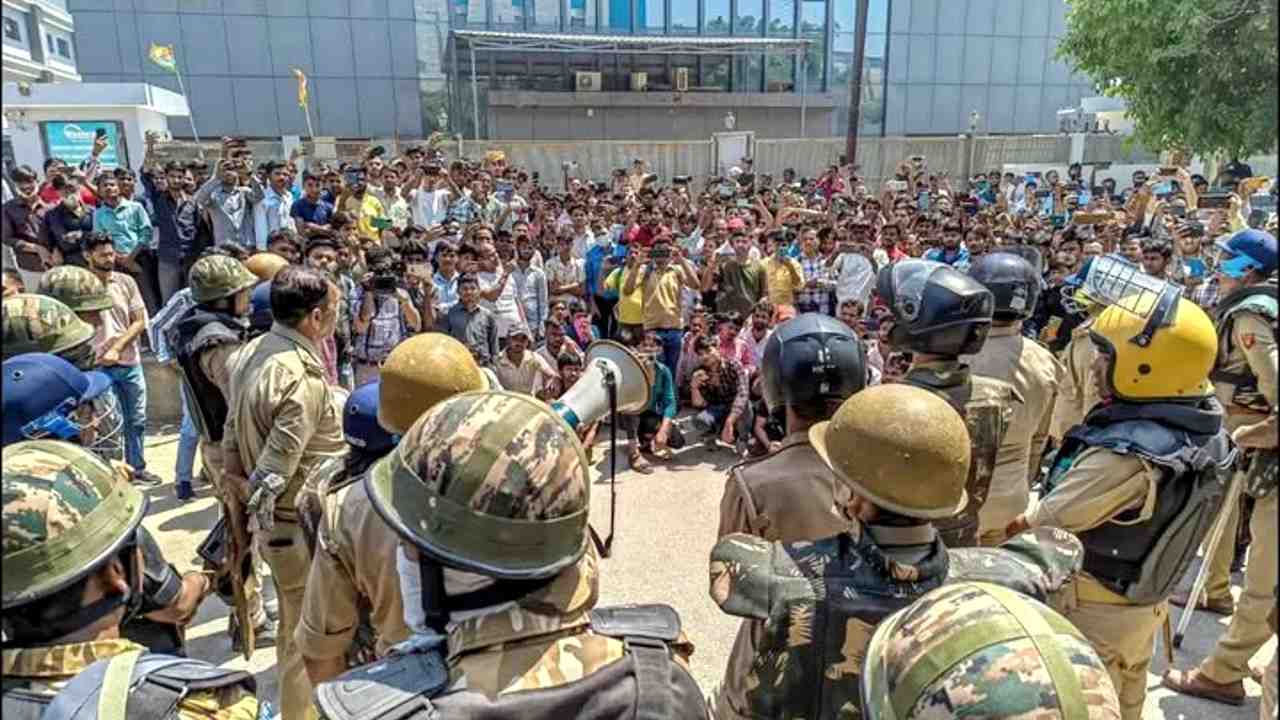
Workers across the border in Uttar Pradesh, employed by the same multinational supply chains, demanded the same rate. The state offered 21%. On April 13 and 14, arson and vehicle torching spread across four sectors of Noida, with approximately 45,000 workers on the streets and no union leadership directing them.
This is what the collapse of formal channels looks like in practice. The Labor Codes were designed to streamline collective bargaining and dispute resolution. The Noida workers had bypassed both entirely. The mechanism failed before it was tested.
A state-by-state minimum wage in an economy bound by shared supply chains cannot diverge without consequences. Haryana discovered this within 72 hours of its own concession. The government has no national floor wage to fall back on. That absence is now a live emergency.
The politics of exhaustion
The political reach of the unrest is its most telling feature. The Bharatiya Mazdoor Sangh, an RSS affiliate and ideological ally of the ruling BJP, acknowledged the genuine concerns driving the protests. This is not the language of a party that believes the crisis belongs to the opposition.
In Maharashtra, 1.7 million state government employees, teachers among them, began an indefinite strike on April 17 over a pension revision the government agreed to in 2024 but never formalized, as reported by The Hindu.
The state invoked emergency legislation and classified the strike as misconduct. Treating a pension dispute as a law-and-order problem is the response of a government that has run out of political ones.
The factories absorbed the damage in the only way available to them. Tata Motors raised commercial vehicle prices up to 1.5% and passenger models 0.5%, per the Economic Times. Audi India added 2% across its range.
The human cost arrived on April 24. Two factory explosions, one at a Chhattisgarh thermal plant and one at a Tamil Nadu firecracker factory, killed 31 workers combined. The National Human Rights Commission issued notices to both state governments, as confirmed by the Press Information Bureau.
For labor unions, the timing sealed the argument. The codes that were meant to protect workers had not. The channels that were meant to contain grievances had not. What remained was the street.


.jpg)


.jpg)