Lahore reclaims its skies as 3-day Basant festival returns after two decades
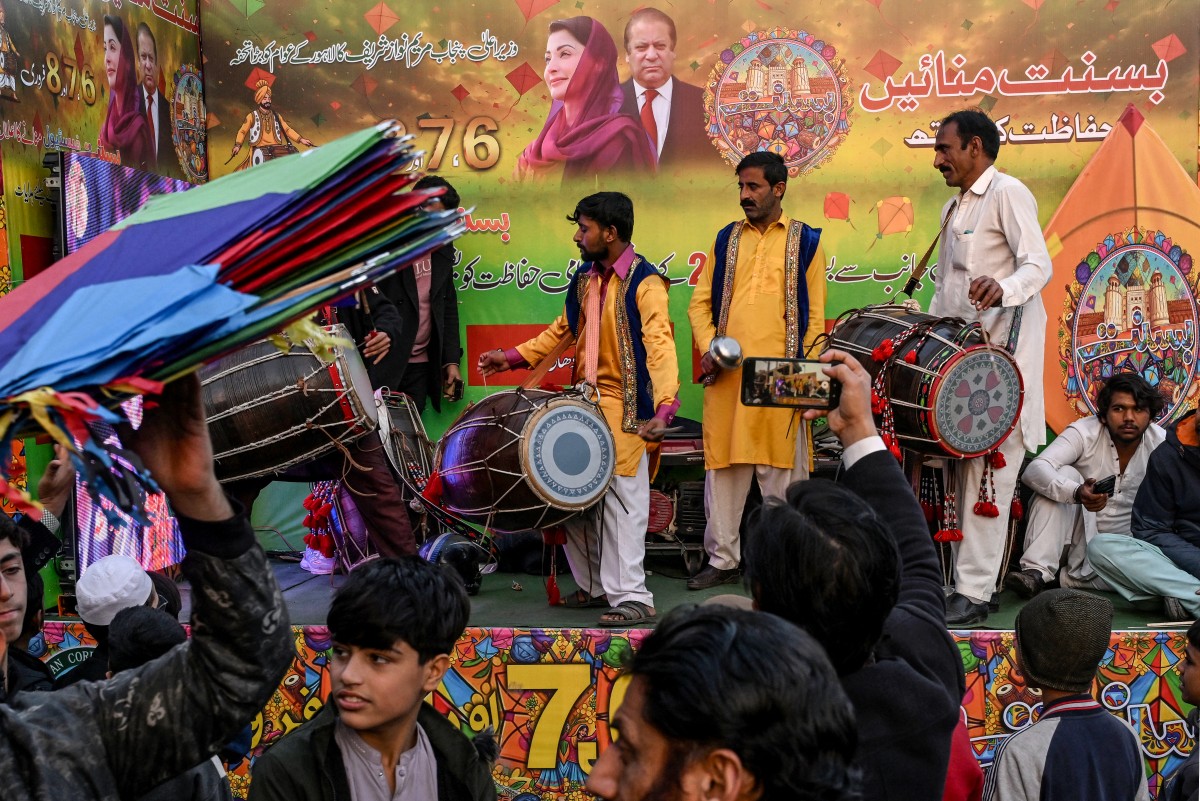
Artists play traditional drums next to a hoarding with portraits of Pakistan Muslim League Nawaz (PMLN) party leaders, as vendors sell kites to mark Basant Festival in Lahore on February 4, 2026. (Photo by Arif ALI / AFP)
For the first time in nearly 20 years, the skies above Pakistan’s cultural capital are once again alive with color.
As midnight passed into Thursday, fireworks flared across Lahore.
Kites began lifting from rooftops, and music echoed through the narrow streets of the Walled City. By dawn, the message was unmistakable: Basant, once a defining symbol of Lahore’s spring, had returned openly, officially, and under the watchful eye of the state.
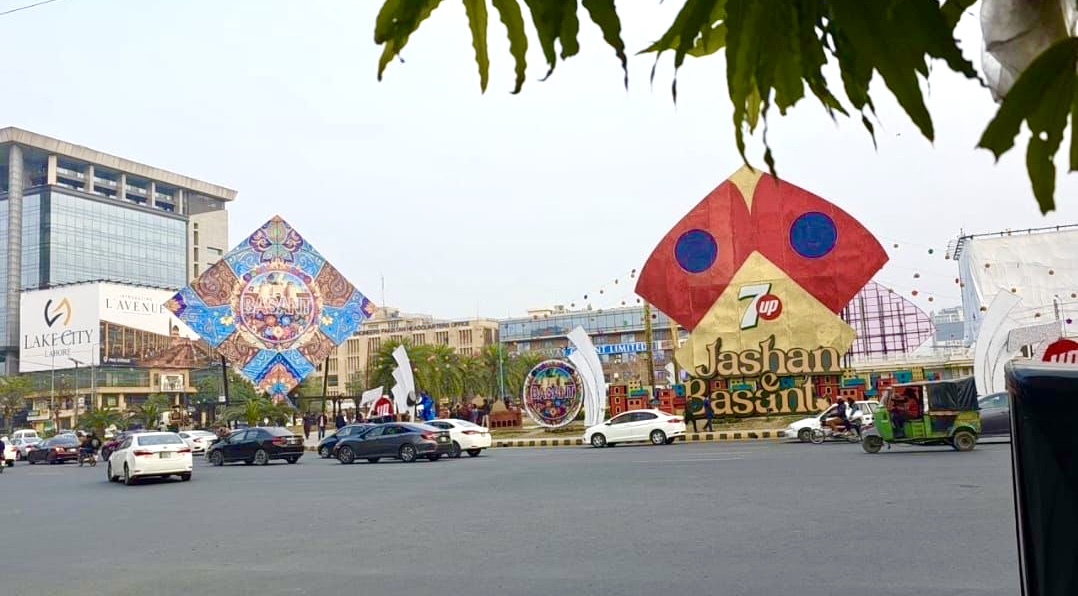
The three-day festival, beginning Feb. 6, marks a turning point for a city that has long associated kite flying with its identity, yet has seen the celebration pushed into the shadows following years of bans and safety concerns. This year, the revival is neither symbolic nor tentative. It is public, regulated, and visibly embraced by the provincial government.
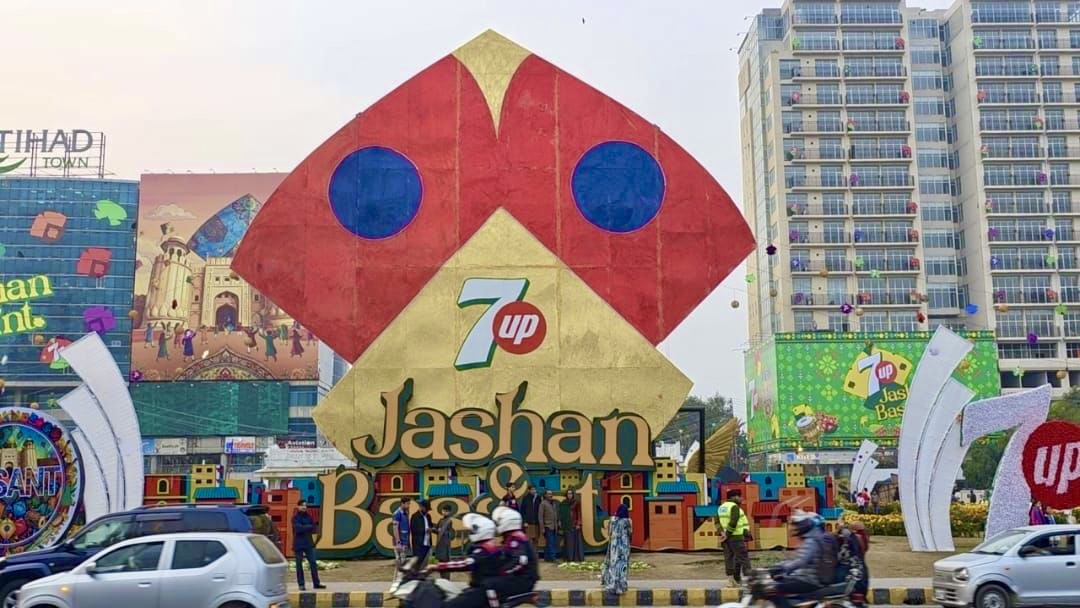
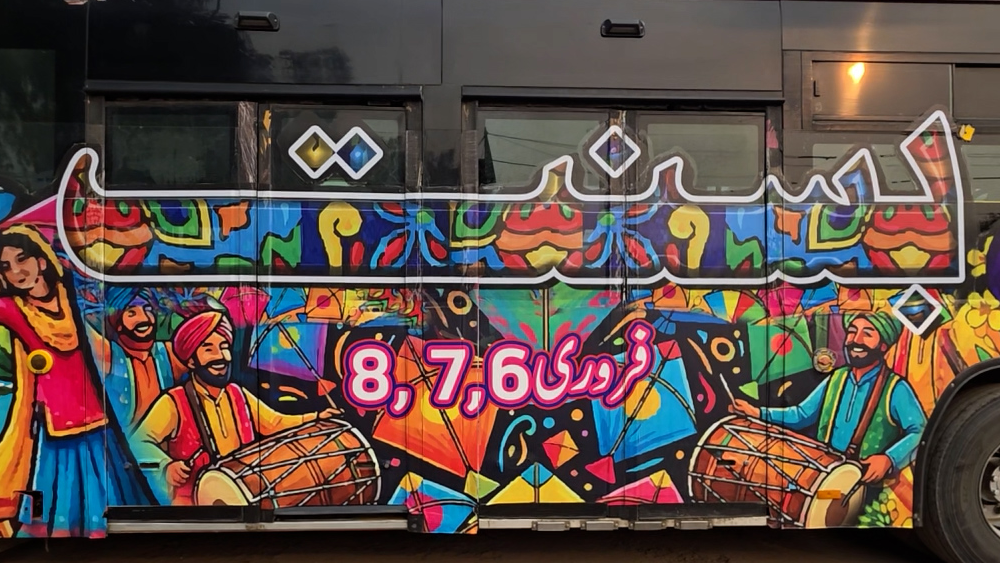
Across Lahore, the transformation was immediate. Main roads, underpasses, and traffic circles were decorated with bright banners and large kite-themed installations.
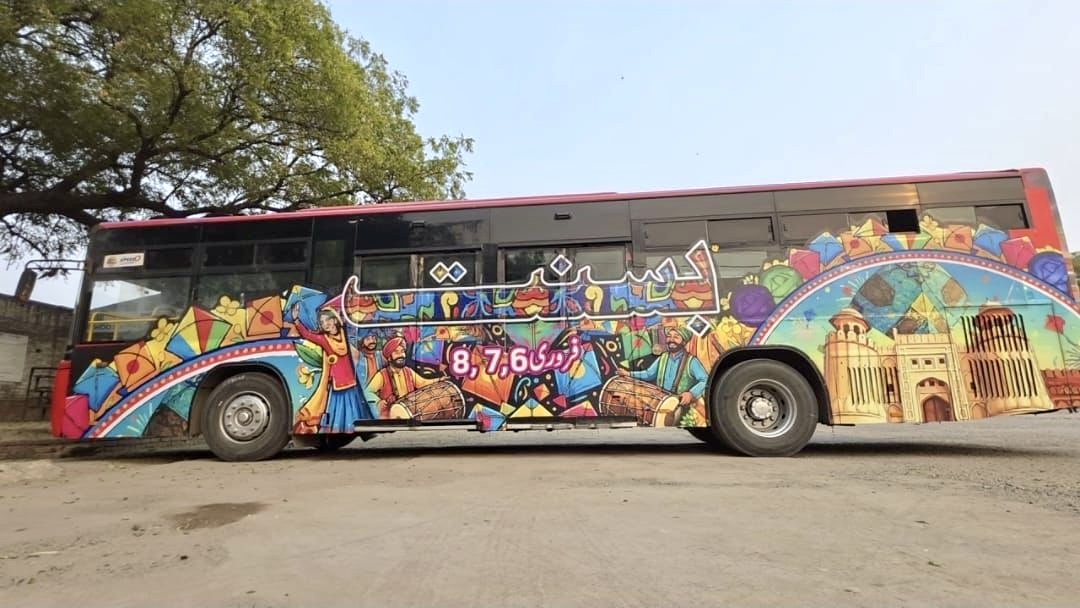
In older neighborhoods, rooftops were adorned with lights, strings, and spools, while entire blocks seemed to pause their daily routines in anticipation of the festivities.
Punjab Chief Minister Maryam Nawaz acknowledged the occasion shortly after midnight, describing Basant as a cultural inheritance rather than a mere event, and extended greetings to citizens as the festival began.
Traditional kite markets, including Mochi Gate, Delhi Gate, Shah Alam Market, and Anarkali, remained busy late into the night as families and young buyers stocked up on supplies. Vendors said interest was cautious in the early days, but demand surged once people became convinced the government-backed revival would proceed as announced.
Liberty Chowk emerged as a focal point of the celebrations, repurposed into a public gathering space illuminated with lights and oversized kite displays. Families, couples, and groups of friends gathered there, signaling a notable shift: Basant was no longer confined to private rooftops but had returned to shared civic life.
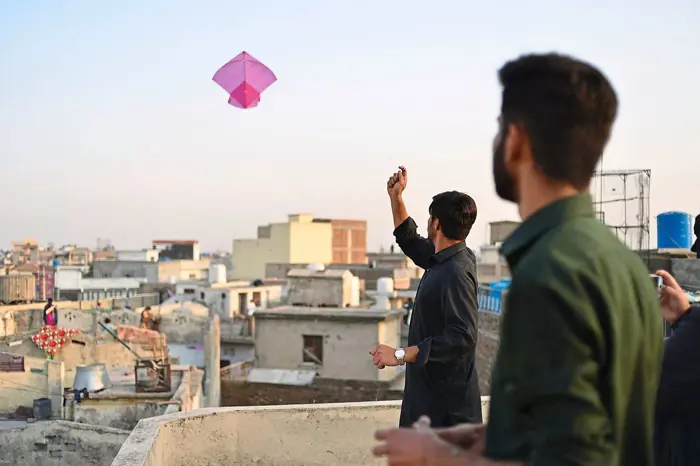
As evening fell, the city’s rooftops reclaimed their historic role as the heart of Basant.
Strings of lights connected neighboring homes, grills were fired up, and relatives gathered for shared meals under open skies. Folk music drifted across districts, punctuated by cheers and the familiar cry of triumph when a kite string snapped mid-air.
Women prepared traditional yellow and white clothing adorned with floral jewelry, while children and elders sorted kites with an ease learned over generations. For many Lahoris, these rituals had never disappeared — only paused.
Yet for a younger generation, the experience was entirely new. Many teenagers and young adults were celebrating Basant for the first time, encountering a festival they had previously known only through family stories and old photographs. Their enthusiasm blended discovery with inherited nostalgia, giving the revival a renewed emotional charge.
Meanwhile, the Chief Minister made an unannounced visit to Liberty Chowk and later to Mochi Gate. Moving through the crowd with minimal security, she interacted with residents, posed for photographs, and addressed safety concerns directly.
During the visit, she stopped a motorcyclist who was riding without a safety rod, a newly enforced requirement, and explained that the measure was designed to prevent injuries and could be installed free of charge at designated points. She reiterated that motorcycles were not banned during Basant, but warned that vehicles lacking safety equipment would be impounded.
Officials and residents alike viewed the visit as a calculated political gesture, reinforcing the message that the festival’s return was both sanctioned and here to stay.
According to Malik Faizan Ahmed, legal adviser to the Kite Flying Association, the scale of public participation has altered the political calculus surrounding Basant.
“The response has been so strong that reversing this decision would now be extremely difficult for any future government,” he said, adding that the festival has regained broad social acceptance.
Administratively, the celebrations are unfolding under strict controls. The Punjab Home Department has designated February 6-8 as “Safe Basant” and has imposedcertain restrictions to regulate public order. Metallic and nylon kite strings remain banned, motorcycles must be fitted with safety rods, and emergency services have been placed on high alert.
More than 10,000 police personnel have been deployed across Lahore, supported by checkpoints, surveillance systems, and zero-tolerance enforcement. Authorities insist the objective is not to restrict, but to ensure the festival’s sustainability beyond this year.
For Lahore, a city shaped as much by memory as by movement, Basant’s return is more than seasonal festivity. It is a reclamation of public space, cultural confidence, and the simple act of looking up together.
Latest News
Global pressure grows on Israel as Italy, Spain, China criticize Lebanon strikes
3 HOURS AGO
China says it has never recognized Arunachal Pradesh as part of India
4 HOURS AGO
India power plant blast death toll climbs to 19: Police
4 HOURS AGO
Alibaba-backed firm granted Buy Now Pay Later license for Pakistan
6 HOURS AGO
Pakistan's PM begins three-nation visit to Saudi Arabia, Qatar and Turkiye
9 HOURS AGO