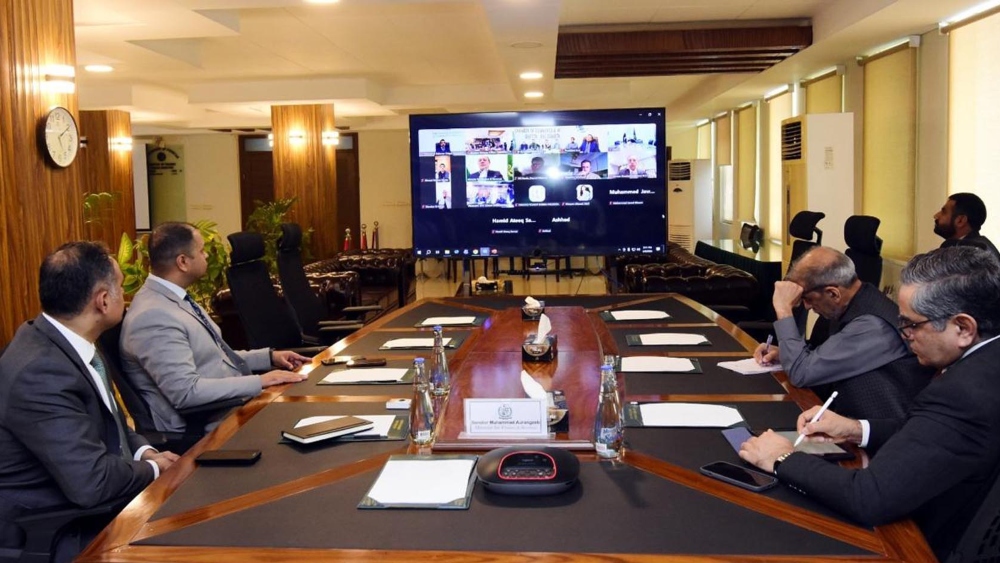
ISLAMABAD: Pakistan Finance Minister Muhammad Aurangzeb convened senior business leaders nationwide to help shape budget priorities and reinforce economic recovery, according to an official statement.
The virtual meeting, chaired by Aurangzeb and attended by Minister of State for Finance Bilal Azhar Kayani alongside senior officials from the Finance Division, Revenue Division and Tax Policy Office, focused on “the prevailing economic situation, upcoming budget priorities, and avenues for strengthening economic recovery and growth.”
Opening the session, Aurangzeb emphasized Pakistan’s evolving economic position, stating the country’s “growing prominence on the global stage amid evolving regional dynamics” and underscoring the need for “regular and structured dialogue with the business community.”
He described the consultation as timely ahead of engagements with international financial institutions, noting the importance of “gather[ing] first-hand insights from key economic stakeholders.”
The minister clarified that discussions extended beyond fiscal measures, saying the engagement aimed at “identifying practical and forward-looking ideas to leverage current opportunities for enhancing trade, attracting investment, and promoting sustainable economic growth.”
Highlighting macroeconomic conditions, Aurangzeb said Pakistan entered recent challenges “from a position of relative macroeconomic stability, supported by fiscal discipline and strengthened external buffers,” reaffirming the government’s commitment to “maintaining economic resilience while ensuring inclusive and durable recovery.”
He pointed to improvements in fiscal management and external obligations, adding that recovery efforts are “grounded in strengthening fundamental economic indicators and institutional discipline, achieved in partnership with the private sector.”
Participants from chambers of commerce and industry presented proposals focused on improving the business environment, boosting exports, and enhancing productivity. According to the statement, discussions emphasized reducing inefficiencies, improving infrastructure utilization, and aligning policies with regional benchmarks.
Business representatives also called for improved liquidity flows, support for export-oriented sectors, and diversification of markets to expand Pakistan’s global trade footprint.
They stressed the importance of “policy predictability” and continued consultation in the budget process.
In closing remarks, Kayani said the proposals were “aligned with the government’s reform agenda” and stressed prioritizing measures that deliver “maximum economic impact within available fiscal space, while ensuring practical and implementable solutions.”
Officials from the Tax Policy Office and Federal Board of Revenue assured participants that submissions were “being carefully evaluated to formulate balanced and effective policy measures,” adding that “continuous stakeholder engagement would remain central to shaping a responsive and growth-oriented budget.”
Concluding the meeting, Aurangzeb reiterated the government’s commitment to collaboration, stating that “sustained collaboration between the public and private sectors will be essential” to achieve “stability, resilience, and sustainable growth.”



.jpg)
.jpg)

.jpg)
.jpg)